The UCI Ecological Preserve offers unique opportunities to study local coastal sage scrub and grassland ecosystems a few steps from campus. This proximity makes it the perfect location for long-term research studies that create engaging opportunities in field data collection for undergraduates and accessible field sites for graduate studies.
International Drought Experiment: DroughtNet
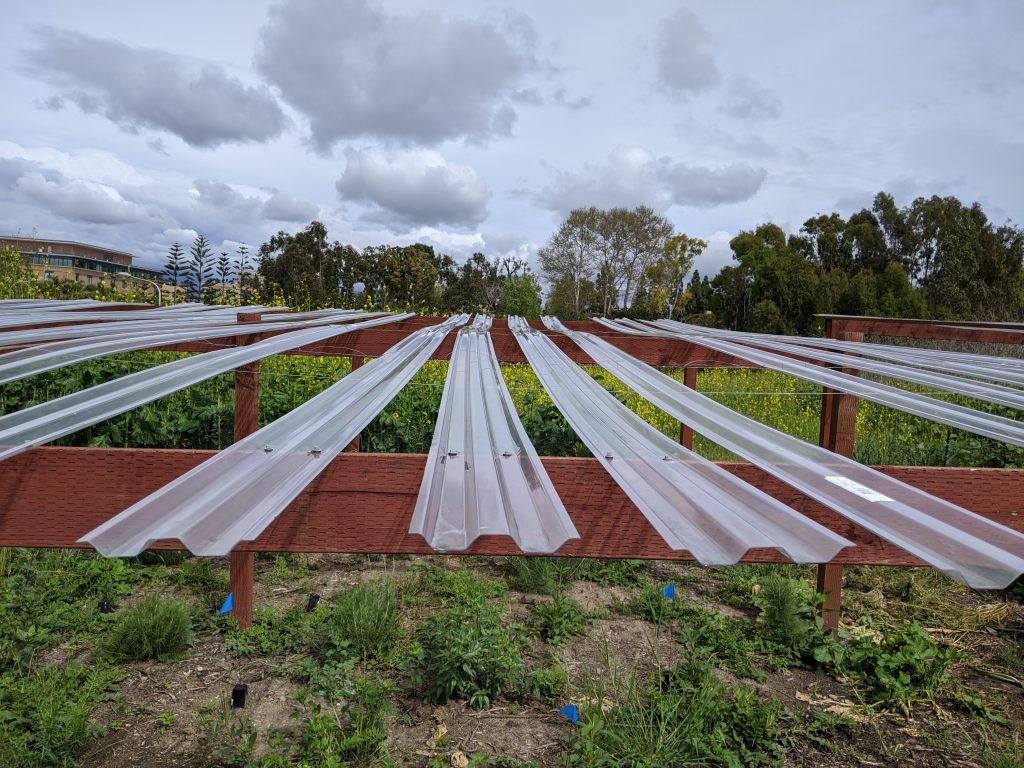
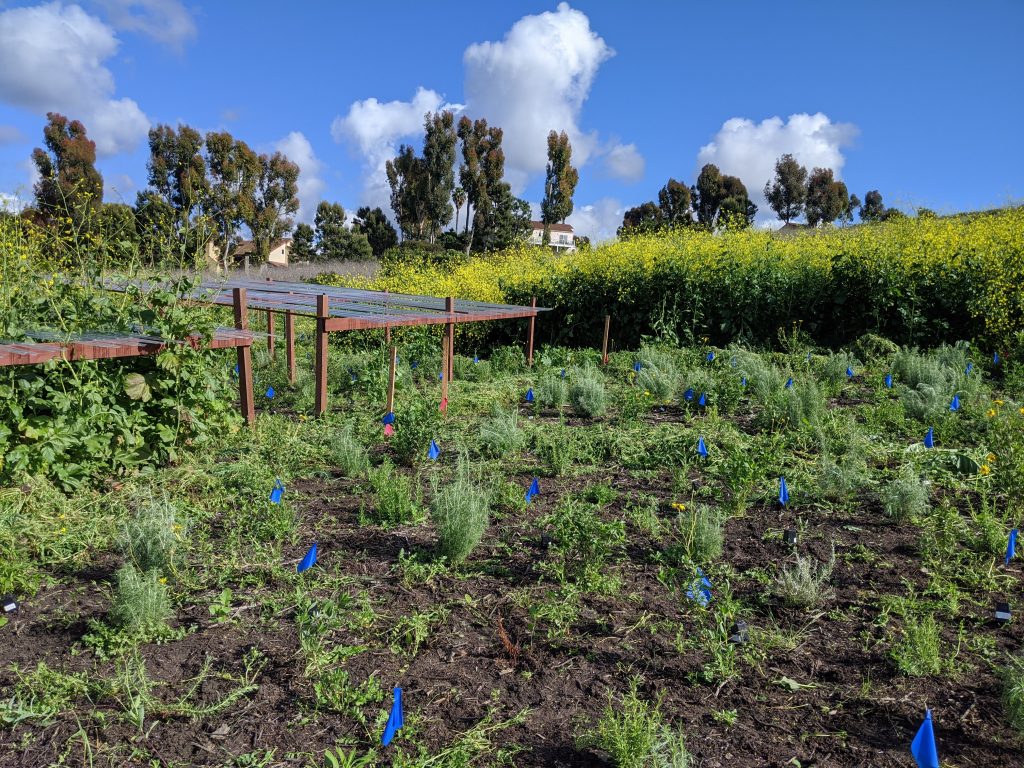
Climate models predict increased variability in precipitation in the decades to come. The UCI DroughtNet Restoration experiment seeks to determine how increased frequency and severity of drought will affect Coastal Sage Scrub communities by subjecting plants to different water manipulations. This is part of an international set of drought experiments studying the impact of extreme drought on different ecosystems.
UCI’s experiment goes further than other drought studies by asking: Will plants from warmer, drier, inland populations be better adapted to drought than plants from cooler, wetter, coastal areas? Seed of common plant species were collected from 4 coastal (mesic) and inland (xeric) source populations, and their survival and performance will be tracked over time.
Below: Dr. Kathleen Treseder provides an overview of a collaborative DroughtNet Restoration Experiment
UCI Ecological Preserve Defensible Space Demonstration Project

This project focuses on the Fuel Modification Zone (FMZ) between the Ecological Preserve and the University Hills housing community. This FMZ is in place to reduce the risk of any potential wildfire that breaks out in the Ecological preserve from spreading to the University Hills housing community. Common practices for a FMZ is to seasonally mow plant material or plant non-native, invasive succulents such as ice plant to reduce the risk of fire. This project explores ways to meet fuel modification standards while maintaining or even increasing the natural biodiversity in these areas. The first phase of this project included introducing two native succulents, coastal prickly pear (Opuntia littoralis) and the coastal cholla (Cylindropuntia prolifera) to the site. The second, and current phase involves planting and seeding a wide variety of native grasses and forbs that have been approved by the OC Fire Authority to be a low fire risk. This experiment has shown that it is possible to lower the risk of fire while providing habitat, in this case for the Coastal Cactus Wren which nests within the cacti and is listed as a species of concern.
Download the Wildfire Safety and Healthy Habitats Demonstration Project poster (pdf file)
Graduate Student Spotlight: Lydia Dean
Lydia Dean is a PhD student in the Mooney lab with a study set up in the Ecological preserve. Read below to learn more about their research.
Exploring the role of herbivore-induced plant volatiles in mediating indirect defense by insectivorous birds
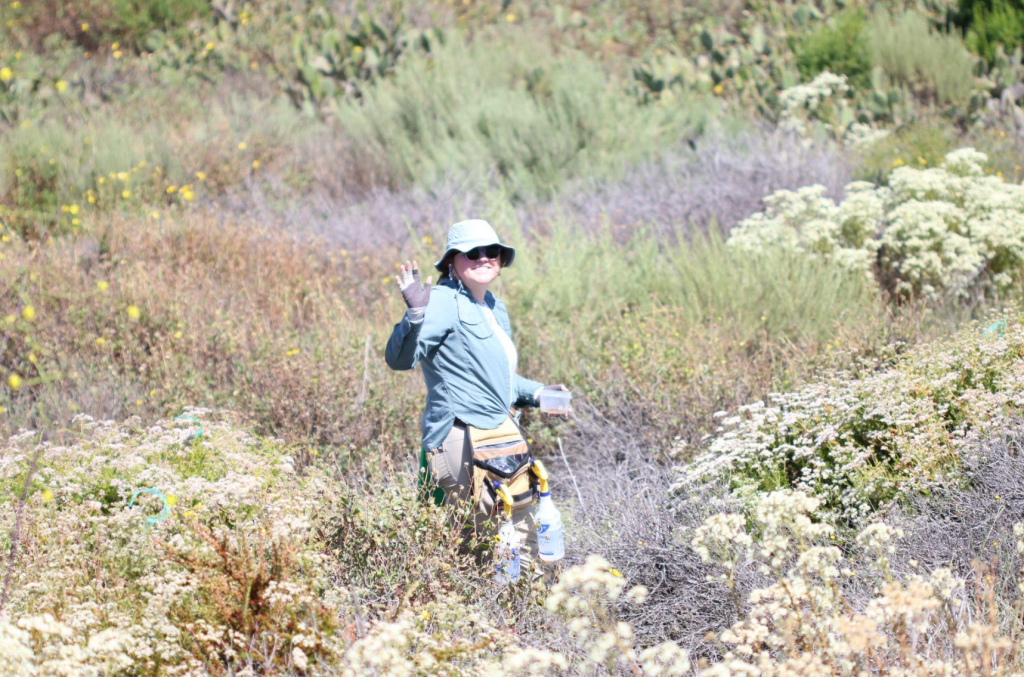
Plants have evolved a myriad of defense traits to repel insect herbivores, such as direct chemical (e.g., reducing palatability and nutritional content) and physical defenses (e.g., trichomes and leaf toughness). Indirect defense traits can provide food rewards, shelter (e.g. extrafloral nectaries and domatia), or foraging cues to arthropod natural enemies to increase their abundance around the plants, which subsequently reduces herbivory and benefit plants. Foraging cues can be provided by plant volatiles, which are organic compounds emitted by plants into the surrounding air. These are induced upon attack by herbivores, and the specific compounds and their blends have been found to attract natural enemies of the herbivores (e.g. arthropod predators and parasitoids) to the plant. However, the mechanisms in which plants may mediate the foraging of insectivorous birds, which are important predators of herbivore insects and thus beneficial to plants, is not yet fully characterized. Thus, this project investigates how herbivore-induced plant volatiles may mediate foraging of insectivorous birds as a form of indirect plant defense.
To do so, I am simulating herbivory on the plants using methyl jasmonate (a plant hormone that triggers the same biosynthetic pathway as herbivores) and then measuring predation rate on induced and control plants. I record predation on the plants using clay caterpillars (model caterpillars made from non-hardening clay that leaves an imprint of the attacker upon attack) and live mealworms. I am conducting this work on three plant species, California sagebrush (Artemisia californica) and California buckwheat (Eriogonum fasciculatum) located in the UCI Ecological Preserve, and on mulefat (Baccharis salicifolia) located in the UCI San Joaquin Marsh Reserve. This work will provide insight into plant defense theory and interspecific variation in the plant defensive syndromes, contributing to our understanding of bird-mediated indirect defense.